
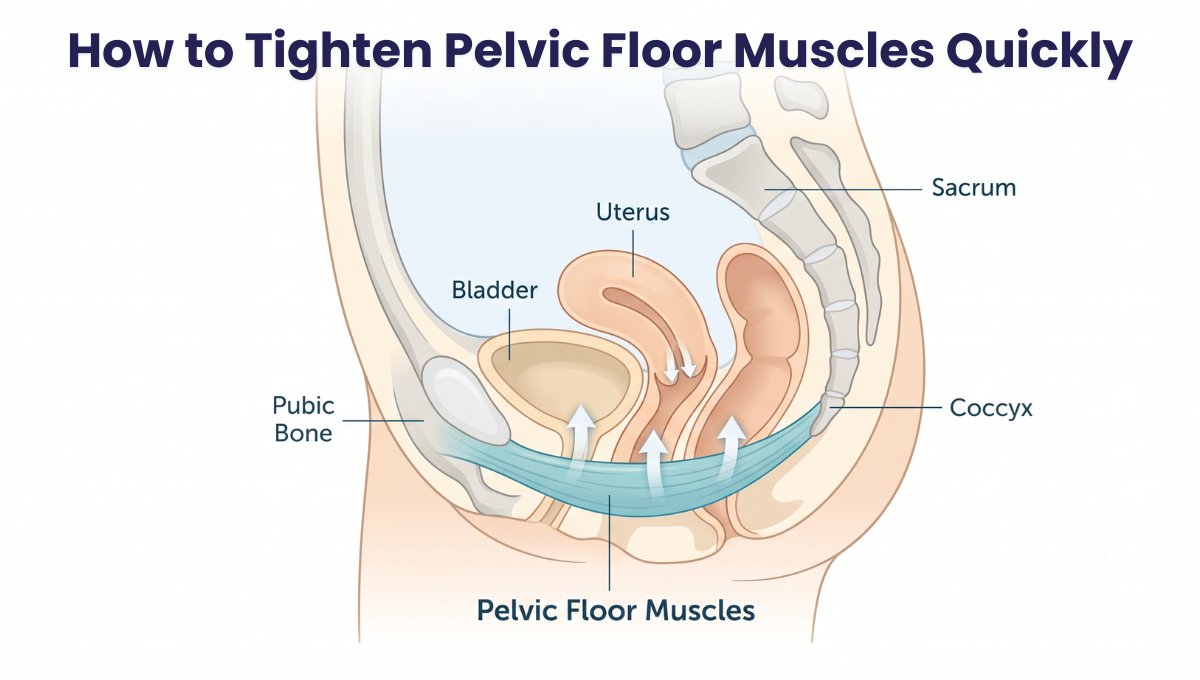
How to Tighten Pelvic Floor Muscles Quickly
If you’re searching for how to tighten pelvic floor muscles quickly, you’re probably looking for something practical: exercises you can start today, a routine that doesn’t take much time, and a realistic idea of when you might notice a difference.
The good news is that pelvic floor muscles can be trained. Kegel exercises, also called pelvic floor muscle exercises, are commonly used to strengthen these muscles, and both men and women can benefit from pelvic floor training.
The important distinction is between quickly starting and getting instant results. Muscles generally need repeated, correctly performed training to become stronger. There is no reliable one-day method for permanently tightening the pelvic floor, and doing more exercises is not necessarily better.
The safest approach is to learn the correct contraction, allow the muscles to relax fully, progress gradually, and stay consistent.
Quick Answer: How Can I Tighten My Pelvic Floor Muscles Quickly?
The fastest safe approach is to begin with correctly performed pelvic floor exercises, such as gentle Kegels, while allowing complete relaxation between contractions. Start with a manageable number of repetitions, gradually increase the challenge, and practice consistently. If exercises cause pain or you cannot identify the correct muscles, consider guidance from a healthcare professional or pelvic floor physical therapist.
Can You Tighten Pelvic Floor Muscles Quickly?
You can start training your pelvic floor immediately, but strengthening takes time.
Pelvic floor muscles respond to exercise much like other muscles: technique, repetition, recovery, and consistency matter. Cleveland Clinic notes that beginners should gradually build the duration and number of contractions rather than expecting immediate changes.
A reasonable goal is therefore not to search for a “one-minute fix,” but to find the fastest safe and sustainable routine you can perform correctly.
That usually means:
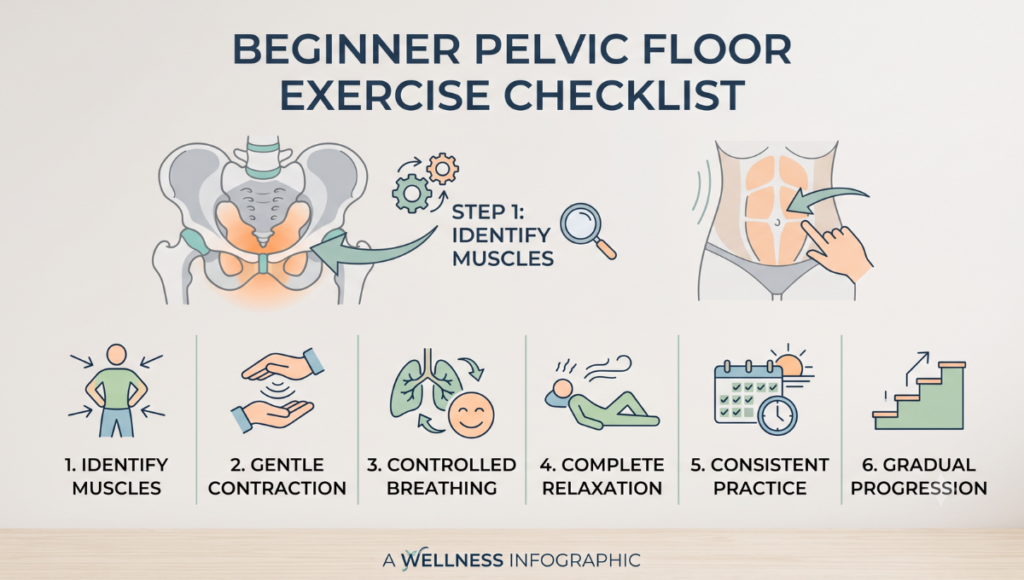
- Identifying the correct pelvic floor muscles
- Performing controlled contractions
- Relaxing completely between repetitions
- Avoiding excessive squeezing
- Practicing consistently
- Increasing difficulty gradually
- Getting professional guidance when symptoms or technique are unclear
The key takeaway: quick progress starts with correct technique, but meaningful strengthening usually requires continued practice.
What Are the Pelvic Floor Muscles?
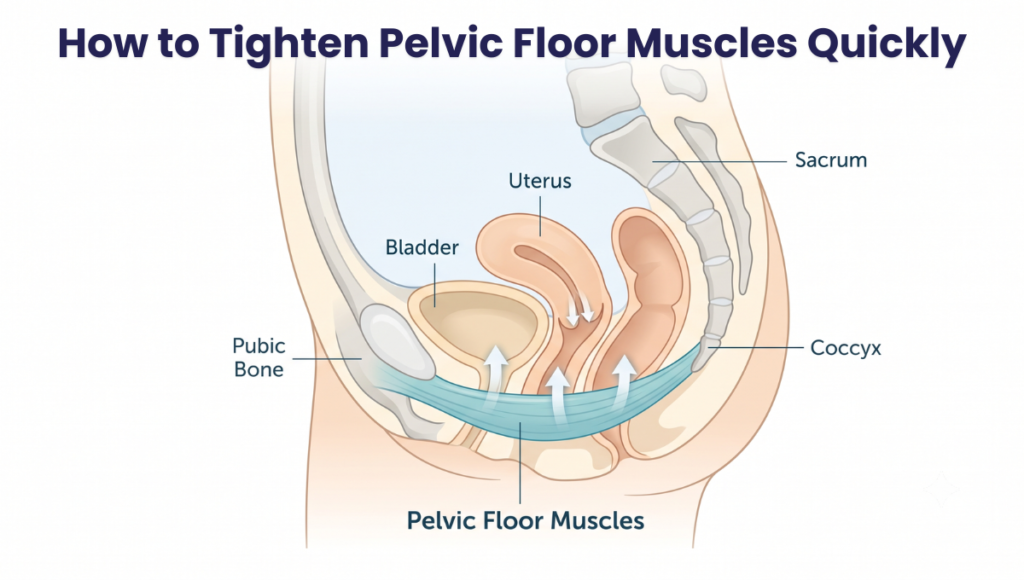
The pelvic floor is a group of muscles and connective tissues located at the base of the pelvis. These muscles help support pelvic organs and play an important role in bladder and bowel control. They also work with other muscles involved in movement and pressure management.
Kegel exercises specifically target the pelvic floor muscles by contracting and relaxing them. Both men and women can perform these exercises.
A useful way to understand pelvic floor training is to think of it as coordination as well as strength.
A healthy pelvic floor needs to contract when appropriate and relax when appropriate. Constantly clenching the muscles isn’t the goal.
In fact, Cleveland Clinic cautions that doing too many Kegels or performing them when they’re not appropriate can contribute to excessive muscle tension.
Signs You May Have a Weak Pelvic Floor
A weak pelvic floor can sometimes be associated with symptoms involving bladder or bowel control. For example, some people experience urine leakage when coughing, laughing, sneezing, lifting, or exercising.
Pelvic floor weakness can have many possible causes, including pregnancy, childbirth, aging, surgery, constipation-related straining, and other factors.
Possible signs include:
- Urine leakage during coughing, sneezing, laughing, or exercise
- Difficulty controlling urine
- Accidental bowel leakage
- Difficulty controlling gas
- A feeling that the pelvic floor lacks support
- Changes in pelvic function following pregnancy or surgery
These symptoms don’t automatically mean that weak muscles are the cause. Pelvic floor problems can involve muscles that are too weak, too tight, poorly coordinated, or affected by another condition.
That’s why persistent or concerning symptoms deserve professional evaluation rather than simply adding more Kegels.
How to Tighten Pelvic Floor Muscles Safely
1. Learn the Correct Pelvic Floor Contraction
Before increasing repetitions, make sure you’re using the correct muscles.
One common technique is to imagine that you’re trying to prevent yourself from passing gas or gently stop urine from escaping. The sensation should be a lifting or tightening action in the pelvic floor rather than a forceful squeeze of your abdomen or buttocks.
NIDDK and Cleveland Clinic both recommend learning to identify and contract the pelvic floor muscles correctly.
Try this:
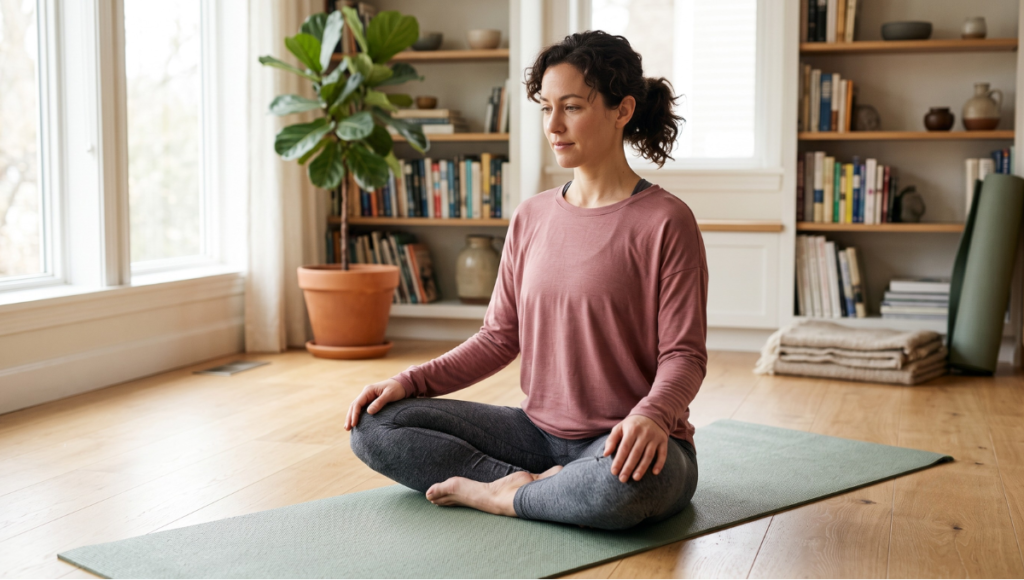
- Sit or lie comfortably.
- Relax your abdomen, buttocks, and thighs.
- Gently contract the pelvic floor.
- Think about lifting the muscles rather than bearing down.
- Continue breathing normally.
- Release completely.
- Rest before repeating.
Important: Don’t routinely practice Kegels while urinating. NIDDK specifically advises against doing pelvic floor exercises during urination.
2. Start With Beginner Kegel Exercises
Once you’ve identified the muscles, start conservatively.
One commonly suggested beginner approach from Cleveland Clinic is to perform a few contractions with short holds and equal relaxation periods, then gradually work toward longer holds and more repetitions as strength improves.
For example, a beginner might try:
- Gently contract for 3 seconds
- Relax for 3 seconds
- Repeat 5 times
- Stop if the muscles become fatigued or technique deteriorates
Over time, a person who is comfortable with the exercise may gradually work toward longer contractions and additional repetitions.
There is no need to force yourself to reach a particular number immediately. The appropriate amount depends on your current strength, symptoms, technique, and health circumstances.
3. Practice Relaxation Between Contractions
Relaxation is an often-overlooked part of pelvic floor training.
The goal isn’t to keep your pelvic floor contracted throughout the day. A complete contraction should be followed by a deliberate release.
This matters because some people have pelvic floor muscles that are already excessively tense rather than weak. In those situations, simply performing more strengthening exercises may not be appropriate. Cleveland Clinic and NIDDK both discuss situations where pelvic floor relaxation or specialized physical therapy may be more appropriate.
During each repetition:
Contract → hold briefly → release completely → rest → repeat.
If you notice pain, persistent pelvic pressure, difficulty relaxing, or worsening symptoms, stop and seek appropriate professional guidance.
4. Progress Gradually
Think of pelvic floor training as progressive exercise rather than a race.
Once a beginner routine feels comfortable, you can gradually increase:
- Hold duration
- Number of repetitions
- Number of daily sessions
- Difficulty of the position
- Coordination with everyday movements
You don’t need to make every workout harder.
A gradual progression gives you an opportunity to maintain good technique rather than compensating with your abdomen, buttocks, or breath-holding.
5. Stay Consistent
Consistency is one of the most important parts of pelvic floor strengthening.
A short routine performed regularly is generally more practical than an intense session that you abandon after several days.
Try attaching your routine to an existing habit, such as:
- After brushing your teeth
- During a quiet morning period
- During an evening wind-down
- After another exercise session
The objective is to make pelvic floor training a normal part of your routine.
A Simple Beginner Pelvic Floor Routine
The following is an example educational routine, not a personalized medical prescription.
| Exercise/Technique | Main Purpose | Beginner-Friendly |
|---|---|---|
| Gentle Kegel | Practice pelvic floor contraction | Yes |
| Full relaxation | Practice releasing tension | Yes |
| Short contractions | Build contraction awareness | Yes |
| Longer controlled holds | Develop endurance gradually | Later |
| Functional coordination | Apply control during movement | Progression |
Example routine
Step 1 — Find a comfortable position
Lie down or sit comfortably and allow your abdomen, thighs, and buttocks to relax.
Step 2 — Perform five gentle contractions
Contract the pelvic floor for about three seconds, then relax for about three seconds.
Step 3 — Rest
Take a short break and breathe normally.
Step 4 — Repeat if comfortable
If the first set feels easy and your technique remains good, you can repeat another small set.
Step 5 — Progress slowly
As the exercise becomes easier over time, gradually increase the hold duration or number of repetitions.
The point isn’t to perform the largest possible number of contractions. It’s to develop controlled contraction and complete relaxation.
How Long Does It Take to Strengthen Pelvic Floor Muscles?
There is no single timeline that applies to everyone. Strength gains depend on factors such as starting muscle strength, exercise technique, consistency, symptoms, age, health history, and the underlying reason for pelvic floor weakness.
Cleveland Clinic notes that people shouldn’t expect results immediately and describes approximately six to eight weeks as a possible timeframe for noticing changes with consistent Kegel practice, while emphasizing that individual circumstances affect the timeline.
That means the answer to “how long does it take to strengthen pelvic floor muscles?” is better expressed as weeks rather than days for many people, with individual variation.
If you’re practicing consistently and see no improvement—or if symptoms are getting worse—a healthcare professional can help determine whether your technique or underlying problem needs further attention.
Do Kegels Really Tighten Pelvic Floor Muscles?
Yes, Kegel exercises are specifically designed to strengthen the pelvic floor muscles by repeatedly contracting and relaxing them.
However, “tighten” can be misleading if it suggests that the muscles should remain contracted all the time. Effective pelvic floor function involves both contraction and relaxation.
Kegels may be useful for people with pelvic floor weakness, but they aren’t automatically appropriate for every pelvic floor problem. Someone with excessive pelvic muscle tension may need relaxation-focused treatment instead.
How Many Kegels Should You Do a Day?
There isn’t one universal number that is right for everyone.
Cleveland Clinic provides a gradual example that can eventually progress toward sets of up to 10 contractions, with several sets per day, but it also recommends starting with a manageable number and increasing gradually.
For beginners, quality matters more than quantity.
A useful principle is:
Start small → use correct technique → relax fully → increase gradually.
If you find yourself clenching your stomach, buttocks, or thighs, holding your breath, or experiencing pain, doing more repetitions isn’t the answer.
What Is the Fastest Safe Way to Strengthen the Pelvic Floor?
The fastest safe approach is not necessarily the most intense one.
Instead, focus on:
- Correct muscle identification
- Controlled contractions
- Complete relaxation
- Consistent practice
- Gradual progression
- Professional assessment when needed
Pelvic floor physical therapy can be particularly useful when you’re unsure which muscles to activate or whether your muscles are weak, tight, or poorly coordinated. Physical therapists trained in pelvic floor care can use techniques such as individualized exercise instruction and biofeedback.
Common Pelvic Floor Exercise Mistakes
Avoiding mistakes can be just as important as performing the exercises.
Mistake 1: Squeezing everything
Your buttocks, thighs, and abdominal muscles shouldn’t be doing all the work.
Mistake 2: Holding your breath
Continue breathing normally during contractions. Breath-holding can make the exercise less controlled.
Mistake 3: Never relaxing
The pelvic floor needs to release between contractions.
Mistake 4: Doing hundreds of repetitions
More isn’t automatically better. Excessive Kegels can contribute to excessive muscle tension in some people.
Mistake 5: Practicing while urinating
Kegels shouldn’t routinely be performed during urination.
Mistake 6: Expecting instant results
Muscle strengthening requires repeated practice.
Mistake 7: Ignoring pain
Pain isn’t a signal to simply push harder. If pelvic floor exercises cause pain, stop and seek professional guidance.
Can You Strengthen Your Pelvic Floor Naturally?
Yes. Pelvic floor muscles can be trained through exercises such as Kegels, along with appropriate movement and physical therapy when indicated.
NIDDK identifies pelvic floor muscle exercises as a way to strengthen these muscles, and notes that both men and women can benefit.
However, “naturally” doesn’t mean that every pelvic floor concern should be handled without professional input.
Persistent urinary or bowel symptoms, pelvic pain, prolapse symptoms, or problems following surgery or childbirth may require individualized assessment.
Can Men Strengthen Their Pelvic Floor Muscles?
Yes. Men have pelvic floor muscles and can perform pelvic floor muscle exercises.
NIDDK notes that pelvic floor exercises can help strengthen these muscles in men and women. In men, pelvic floor training may be relevant to certain bladder-control concerns, depending on the underlying cause.
Men with persistent urinary symptoms, pelvic pain, prostate-related concerns, or other medical issues should discuss an appropriate exercise approach with a healthcare professional.
Can Women Strengthen Their Pelvic Floor Muscles?
Yes. Women can strengthen their pelvic floor muscles through pelvic floor muscle training.
Pelvic floor exercises are commonly used to improve muscle strength and control, including in women experiencing certain forms of urinary leakage.
Pregnancy, childbirth, menopause, aging, surgery, and other circumstances can affect pelvic floor function, but the right exercise approach varies from person to person.
When You Should Speak With a Healthcare Professional
Pelvic floor exercises are not a substitute for evaluating unexplained or persistent symptoms.
Consider speaking with an appropriate healthcare professional if you experience:
- Pelvic pain
- Pain during pelvic floor exercises
- Significant urinary leakage
- Bowel leakage
- Difficulty emptying your bladder
- A feeling of pelvic pressure or bulging
- Symptoms associated with pelvic organ prolapse
- Significant symptoms during pregnancy or after childbirth
- Symptoms that worsen when you exercise
- Uncertainty about whether your pelvic floor is weak or overly tense
A pelvic floor physical therapist can help determine which muscles need strengthening, relaxation, coordination, or other individualized work.
This distinction matters because not every pelvic floor problem is caused by weakness.
Can a Structured Pelvic Floor Program Help?
A structured program can be useful for people who understand that consistency matters but struggle to create a routine themselves.
Pelvic Floor Strong is marketed as an at-home pelvic floor and core fitness program for women. Its current program materials describe guided exercise content, educational material, and a three-step movement approach involving the pelvic floor and core.
The program’s materials also describe video instruction and written resources designed to help users follow the exercises at home.
That can make it worth considering if you prefer:
- Guided rather than self-directed workouts
- Video demonstrations
- A structured routine
- Educational material alongside exercises
- Home-based exercise
However, it’s important to keep expectations realistic. Pelvic Floor Strong is a fitness and educational resource, not individualized medical care, and a commercial program shouldn’t replace assessment or treatment from a qualified healthcare professional when symptoms require it.
The program’s own materials describe its approach and contents; those descriptions should not be interpreted as independent evidence that the program will produce a particular medical outcome for every user.
Frequently Asked Questions
1. How can I tighten my pelvic floor muscles quickly?
Start with gentle, correctly performed pelvic floor contractions and practice consistently. Focus on identifying the correct muscles, breathing normally, relaxing fully between repetitions, and increasing the workload gradually. There is no reliable instant method for permanently strengthening the pelvic floor, and individual progress varies.
2. How long does it take to strengthen pelvic floor muscles?
Many people need several weeks of consistent practice rather than a few days. Cleveland Clinic notes that some people may notice changes after roughly six to eight weeks of regular Kegel exercise, although individual results vary based on starting strength, technique, consistency, and other factors.
3. Do Kegel exercises really work?
Kegels are designed to strengthen the pelvic floor muscles and can be useful for appropriate pelvic floor concerns. NIDDK and Cleveland Clinic both recognize pelvic floor muscle exercises as a way to strengthen these muscles. However, Kegels aren’t appropriate for every pelvic floor problem, particularly when excessive muscle tension is involved.
4. How often should I do pelvic floor exercises?
Start with a manageable routine rather than trying to maximize repetitions. One clinical education example gradually works toward several sets per day, but beginners should build up according to their ability to maintain correct technique. If exercises cause pain or increasing tension, seek professional guidance rather than simply increasing frequency.
5. Can I do pelvic floor exercises every day?
Pelvic floor exercises can be incorporated into a regular routine, but daily practice doesn’t mean continuously squeezing the muscles. Adequate relaxation between contractions is important. If you develop pain, persistent tightness, or worsening symptoms, stop and discuss the situation with a healthcare professional.
6. Can men do pelvic floor exercises?
Yes. Men can strengthen their pelvic floor muscles with exercises such as Kegels. NIDDK specifically notes that pelvic floor exercises can benefit both men and women. The appropriate exercise plan depends on the individual’s symptoms and underlying health circumstances.
7. Can women do pelvic floor exercises?
Yes. Women can perform pelvic floor exercises and may use them to strengthen pelvic muscles and improve control. They can be especially relevant after circumstances that affect pelvic floor function, such as pregnancy or childbirth. However, persistent symptoms or pelvic pain warrant individualized professional assessment.
8. What should I avoid when doing Kegels?
Avoid squeezing your buttocks, thighs, or abdomen excessively; holding your breath; performing contractions while urinating; and doing so many repetitions that your muscles become excessively tense or fatigued. Focus on a gentle contraction followed by complete relaxation.
9. What if pelvic floor exercises cause pain?
Stop the exercise rather than pushing through pain. Pelvic pain can have several possible causes, and some people have overly tense pelvic floor muscles rather than weak muscles. A pelvic floor physical therapist or other appropriate healthcare professional can help determine what type of exercise or treatment is suitable.
10. Can a structured program help me stay consistent?
It can. A structured program may make it easier to follow demonstrations, schedule workouts, and progress gradually. Pelvic Floor Strong, for example, describes itself as an at-home program with educational material, video instruction, and a structured movement sequence. Whether it is appropriate for you depends on your goals and health circumstances.
A Simple Takeaway
If you’re wondering how to tighten pelvic floor muscles quickly, don’t focus exclusively on doing more repetitions.
Focus on doing the basics well:
- Identify the correct pelvic floor muscles.
- Contract gently and deliberately.
- Keep breathing normally.
- Relax completely after each contraction.
- Practice consistently.
- Progress gradually.
- Stop if exercise causes pain.
- Seek professional guidance when symptoms are significant or unclear.
Pelvic floor strengthening is a process. A realistic goal is to build better muscle control and strength over time rather than chase an overnight result.
A structured resource such as Pelvic Floor Strong may be useful for people who prefer guided exercise, but it should be viewed as an educational fitness option rather than a replacement for individualized healthcare.